 |
| A classic French Citroën 2CV ~ The 2CV stands for "deux chevaux" (2 horses). Citroēn introduced the car in the 1940's to entice France's many farmers who were still using horses & carts... |
| But it's all soft experiential adventures... We don't have you jumping out of airplanes with a parachute, scaling large mountains or swimming with sharks... But for a lot of our guests, just the idea of driving in France is one small part of these experiential adventures! And while you may feel a little hesitant now, we guarantee you that when you come home from France, you'll feel very proud & worldly that you did it! While sometimes our guests have previously been to Europe, often times those trips have been on a mass-market packaged bus tour operated by a large Tour Operator. We assure you, THIS will be different! |
 |
| French STOP sign! |
 |
| red, yellow & green and works just like ours, but this is important: NO RIGHT TURN ON RED IN FRANCE! |
Pictured here is what their Stop Signs and their Traffic Lights look like... No, we're not joking... Their most important traffic signs and lights are just like ours here in the US... And their driver etiquette is pretty much exactly the same... (well, at least the same as in New Jersey! Pennsylvania drivers beware, French drivers are a little more assertive than you are)
So that makes it pretty easy right there! But we'll give you a couple of quick hints here today to help you feel more confident... and in future posts, we'll have more detailed driving lessons and gradually a lot more of the traffic signs... (most are pretty intuitive)
While most of the driving is pretty much the same as here in the states, one difference that you'll notice right away: France has a lot of "traffic circles"... A LOT! We'll write more about these in future posts... but if you want a quick lesson: click here
 |
| I've been getting these on & off for 40 years, and no one has ever asked to see it, but in some countries it is required by law |
International Drivers License: We've had recent questions about this... If you've been with us on our Tuscany, Italy expeditions, and many of you have, you'll remember we told you you needed an International Drivers Permit. So in France it is not required. Many online articles say it's recommended, but it is definitely not required by law. If your rental car company has told you that you must have one to rent the car, then by all means, you should get one. ( they're easy to get; $20 at AAA offices). You do of course need your US drivers license, so if you're going to be driving, make sure you have that with you!
Insurance: So we've had questions on this already... When renting a car in France it is required by law that drivers carry unlimited third party liability insurance, and as a result it is automatically included in the price of all car rentals. The advantage of having this car rental insurance in France is that you are protected from injury, death or property damage to others which occur while operating your rental during your trip to France. But you do need to be attentive to CDW (Collision Damage Waiver) and Theft Protection. We always suggest you get the full coverage or "zero-deductible" insurance coverage... it might cost you $50 -$75 more for the week, but we think it's well worth the investment... When you turn your rental car in, there's absolutely no question... scratch, dent, knocked the mirror off, backed into a donkey, something broken... it doesn't matter, cause you'll have full coverage! Again, it's a personal decision and totally up to you...
 |
| yes, there are convertibles available! |
Who's Driving: Also we strongly suggest you pay "the additional driver charge" for anyone that might even possibly drive the car... You might say to yourself, "hey, who's gonna know?" And again, no one would know, unless you either get pulled over by a policeman, or get involved in a fender bender... If you're not listed as a driver on the contract, you won't be covered by the insurance! The charge for an additional driver has come down significantly over the years... These days, it's only about 10 euro per day... we suggest if someone else will be driving the car, have them on the contract! You'll do this locally when you pick up the car... Again, this decision is a personal choice...
Before you leave the rental car office: make sure you know whether the car takes regular gasoline or diesel fuel... they have a lot of diesel cars in Europe! Here's an important tip: The French term for diesel fuel is gazole... And Sans plomb is standard octane unleaded gasoline. You may see Sans Plomb 95 which is higher octane unleaded, just like our "premium" gas here in the states. Manned gas stations in more rural areas of France often close for lunch between 12:00 – 14:00, so be sure to time your fill up. Many gas stations along the highways in France have large stores where you can purchase both snacks and hot foods. In my experience these are generally in better condition than gas stations located within cities.

If you put the wrong fuel in the car, the engine will stop working, and it's a very expensive fix, and it won't be covered by the insurance! Also find out how to open the "fuel door..." These latches can be hidden pretty well over there! Adding gas to the car is exactly the same; you can choose full service or self-service... If you choose self-service, you just stick your credit card in the pump, just like here in the US. You'll typically find the best gas prices at large grocery stores.
Car Return: And lastly, on the day you turn your rental car in, fill it up to the very, very, tip-top of the gas tank, right before you turn it in... make sure to keep the receipt... take a picture of the receipt with your phone... show the receipt to the attendant, and make sure he acknowledges, and get him to note that "the car was turned in with a full tank of gas on the paperwork!" Don't try to get by with an "almost full" tank... They will charge you! Remember, they have your credit card! They'll not only charge you $10 a gallon for the "phantom gas," they'll charge you a $25 - $50 "fueling fee"! Again, fill it to the tip-top right before you turn it in & keep the receipt for 3 months! Trust us, we've been doing this for a long time...
Speed Limits: Speed limits in France are probably one of the most confusing aspects of driving. The reason is that you often don’t know the speed limits. For example, the official French speed limits across the whole country are:
- Autoroutes: 130km/hr (80 mph), but that is reduced to 110km/hr (68mph) when raining. There is a further drop to 50km/hr (30mph) in periods of limited visibility (such as snow, fog, etc.).
- N and D Roads: In roads considered single carriageway (one lane in each direction), the speed is 80km/hr (50mph), dropping to 50km/hr (30mph) in poor visibility.
- Local roads and in cities: 50km/hr (30mph).
- Know the speed limits. You are accountable for them, even if there aren’t signs posted. And rarely are speed limit signs posted in France off of major roads.
- Traffic Cameras. These are fixed cameras by the side of the road where speeding is likely (downhills or uphill sections of roadway, transitions from rural highways, entrances to small villages, etc.). The cameras are housed in metal cabinets and point out at the roadway, snapping shots of drivers.
- Private Speed Camera Cars In 2018, France enabled private speed camera cars to catch drivers. These are unmarked vehicles owned by private companies who monitor speeds and take pictures of speeders, but while moving. There are about 500 of these vehicles on the road on a constant basis.
- Seatbelts are required for everyone.
- It is illegal to talk on the phone (even with a hands-free headset) or hold your phone in your hand while driving.
- Reminder: No right turn on red.
- Be careful with alcohol; The BAC limit in France is 0.05% (lower than in the U.S.)
- Headlight use is mandatory at night. And when it is raining. And when driving through a tunnel. And when driving through an emergency or construction zone.
- It is illegal to drive on a bus lane (unless you are a taxi).
- Watch for motorcycles and mopeds. They can be difficult to see! And often break traffic laws for convenience.
- On roadways, it is illegal to cross a solid white line (such as overtaking/passing, or making a left, or making a right).
- The color of lights matter. Do not proceed or enter an area with a flashing red light (such as a tunnel, etc.). But, you can proceed on a flashing yellow light with caution.
- Pay attention to the fuel grade when pumping at gas stations. The color of the handle is different from what you are used to in the U.S. There are three fuel grades 95-Octane (Sans plomb 95), 98-Octane (Sans plomb 98) and diesel (labeled diesel, gasoil, or gazole depending on the station).
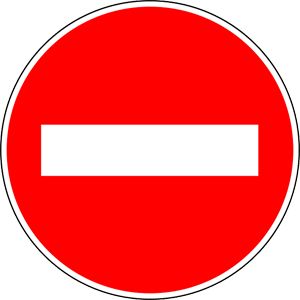 |
| this sign means: No Entry |
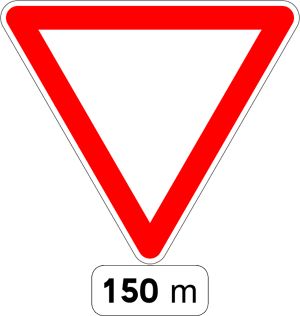 |
| this is a Yield sign indicating a "stop" in 150 meters |
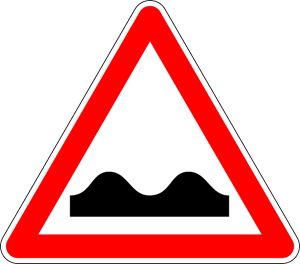 |
| you'll see a million of these in Provence / simply a bump in the road |
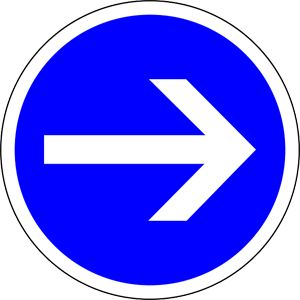 |
| they call these "obligation" signs; you must turn in the direction of the arrow |
